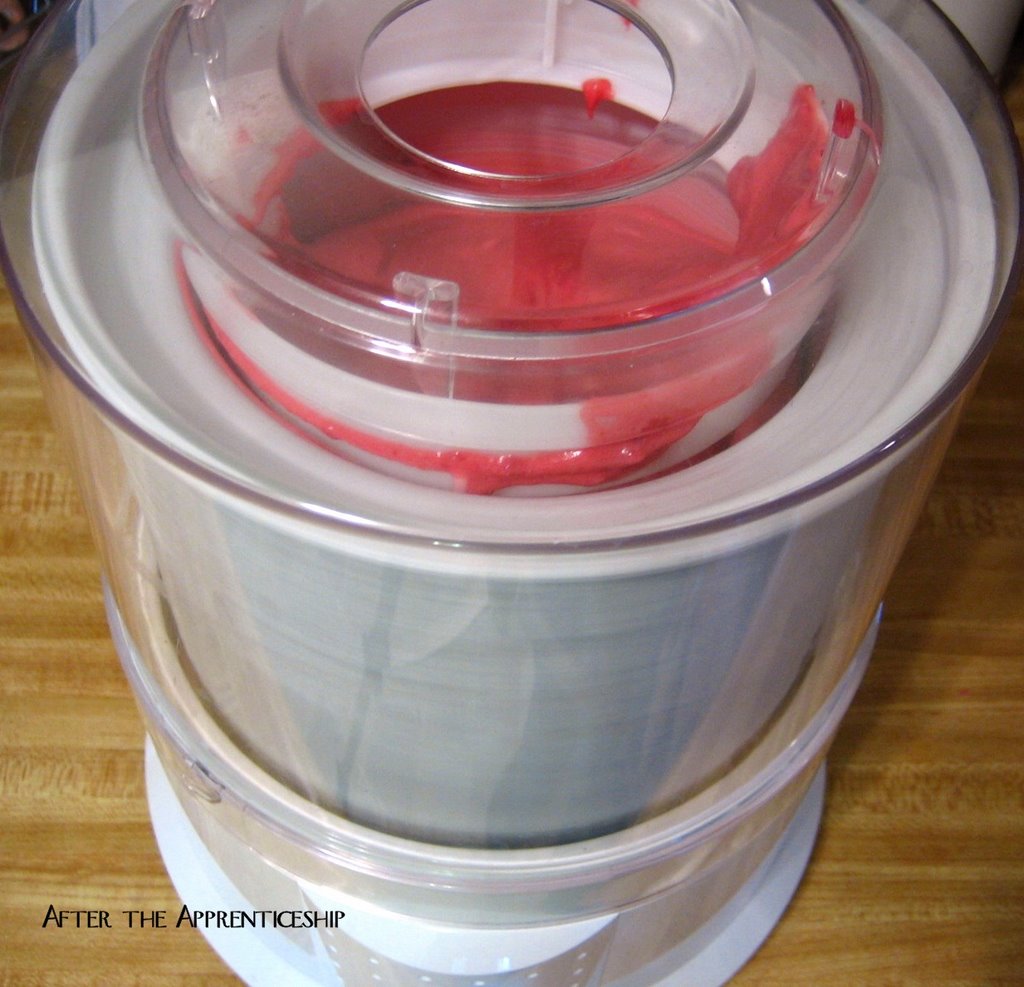
January 21, 2007

Tangerine Meringue Napoleon


I consider the tiny golden globes of clementines and tangerines the perfect late winter dessert, their bright color and generous flavor are a promise of sunny days to come. They are an unabashed reminder from nature to those of us still living in the gray winter of the north that summer will come.


However, the number of bright orange tangerines and clementines that explode out of grocery stores this time of year will be a bit bleaker. 95% of the nation's supply of citrus comes from the San Joaquin Valley in California. The farming region just withstood freezing temperatures that will cost farmers more than $1 billion. The weather has not been kind to the California farmer and will be affect breakfast tables around the U.S.


Not wanting to waste, I had to find a use for my tangerines. This normally isn't a problem, right? Peel. Eat. What's so hard about that? The tangerines I had purchased posed a problem though. What could be wrong with a fruit whose skin comes off in one peel, and when bit into sends a bright burst of sunshine to your taste buds? No, they weren't sour. They had seeds. Now, normally seeds aren't a problem for me. Grapefruit, oranges, I just pick out the seeds--not a big deal. The small fruits though? Especially the really sweet ones that make you wonder why candy was ever invented? I don't want seeds. I want a perfect snack, sans seeds. But who among us could, gasp, throw away a beautiful fruit just because it has seeds? Not I. So I needed a solution. And that came in the form of my hand juicer mixed with the idea of a lemon meringue pie only made with the juice of the tangerines. I turned to the golden standard, Julia Child. The answer, a play on lemon meringue pie, was found in Baking with Julia. Even better? I get to use my blow torch with the recipe. Life couldn't get better than this.

Tangerine Meringue Napoleon

Serves 6, adapted from Baking with Julia

The Tangerine Curd

Ingredients
Eggs - 4 large
Sugar - 1 Cup
Fresh tangerine juice - 2/3 Cup
Zest - 1 tangerine
Unsalted butter - 1/2 stick (2 oz), at room temperature, cut into small pieces Juice from 1/2 lemon

Directions
To make the curd you will need to set-up a double boiler.

1) Bring the water in the saucepan to a simmer while you prepare the tangerine curd.

2) Whip the eggs and sugar at high speed with a whisk attachment until very light and fluffy. With the mixer still running, add the zest and the tangerine and lemon juice.

3) To set the eggs and create a custard, place the mixing bowl over the simmering saucepan and whisk the mixture by hand. If the water in the saucepan touches the bottom of the mixing bowl the eggs could begin to cook, so remove some water if it touches the bottom of the bowl. This will take awhile, but you really want to continue whisking, especially towards the end when the mixture really heats up from the steam and the eggs could congeal. It is done cooking when the consistency is like custard- thick and smooth.

4) Remove from the heat and whisk butter into the custard, piece by piece. 5) Refrigerate until completely chilled and press plastic wrap against the top of the custard.

It can be kept for a week in the refrigerator in an air-tight container. If you need the custard right away, whisk the custard over ice to chill it quickly and store it in the refrigerator until you are ready to serve it. Don't stir it once the curd has set.

The Puff Pastry

Ingredients
Puff pastry - 2 sheets, thawed
Sugar - 6 Tablespoons
Nutmeg -Pinch

Directions
1) Preheat your oven to 350 degrees F.

2) Line 2 baking sheets with parchment, place each sheet of puff pastry on each pan. With a dinner knife cut the puff pastry dough into thirds crosswise. Then, in each third, cut three triangles. Sprinkle with the sugar and nutmeg. Place a piece of parchment over each puff pastry and place a heavy baking sheet on top of the parchment to weigh down the pastry and prevent it from poofing too much.

3) Bake for 10 minutes covered. Take the top baking sheet and the top parchment off of the pastry and bake for 4 more minutes to develop a golden brown color. Remove from oven and place on a cooling rack.


The Meringue
Egg whites - 8 large, at room temperature
Light brown sugar - 3/4 cup (packed), pressed through a sieve

This should be made right before you are ready to serve the dessert. You will need a clean dry mixing bowl and the whisk attachment.

1) Place the egg whites in the mixing bowl and whisk until soft peaks form. Once they have, add the sugar, continuing to mix with the mixer. Whisk the egg whites until shiny, firm peaks form. It should be rather stiff.


Assembling the Napoleons

You will need: Powdered sugar - for dusting, Mint sprigs - for garnish, pastry bag

Spoon the meringue into a pastry bag with a 1/4 inch plain tip and follow the plating pictures and directions below.


1) Place a dollop of curd on the plate to hold the napoleon in place


2) Place pastry on top


3) Spoon curd on top of pastry


4) Pipe meringue in a back and forth motion on top of curd. Brown with torch.


5) Place another pastry on top of meringue and spoon on more tangerine curd.


6) Pipe another layer of meringue on pastry and torch to a golden brown.


7) Place the last piece of pastry on the meringue, sprinkle with powdered sugar and garnish with a sprig of mint. Serve immediately.

Notes:

**Work fast, your dinner guests will be drooling and it takes a bit of planning to plate these quickly.

**Be ready to have everyone wanting seconds.

January 10, 2007

More White Stuff, or What is this? Minnesnowta?


I must apologize. I have been away and my blog has been suffering from lack of posts. But I have a few good reasons...ok, Dad, yes they are just excuses. 1) Week long suffering without power. 2) The holidays (doesn't everyone use this one?). 3)Visiting family in Minnesota. 4) Left digital camera in Minnesota. 5) Looking for/finding new job in an editing department. 6) Engaged! To Mitch. 7)And, thus, Wedding Planning!

So, here I am, back in Seattle and it is snowing again. And quite considerably. Who ever thought that Seattle could be a winter wonderland so many times in one year? Tonight, as I don't have my camera, I thought would be a good time to look over my parents pictures from Italy and dream of balconies overlooking the Mediterranean...


Mountains to climb in my daily jaunt...


The local shopping mall...

And, being a "locavore"-- a word first brought to my attention by the Feb 2007 issue of Food and Wine and, I believe, coined by the San Fransisco group Locavores.
As a side note, what do you think about the term locavore (a person who only eats food that comes from a 100 mile radius of where it was produced)? I wonder if it will cause stress to the hostess and host whose discriminating dinner guest may be a "locavore"? Eating closer to home is a fabulous way to discover regional foods, reduce pollution created in transporting foods, and support communities. But I can't help but think about how privileged we are to be able to eat this way, when so many struggle to have enough food. What would it take to enable all people, regardless of income, to eat healthy, delicious food, while promoting the ideals of the locavore?
One of my favorite things my mom told me about Italy was the way people grocery shop. Every day they walk to the produce stand, the small grocer. They buy a carrot, a stick of celery, a half of a cabbage and go home to make dinner. What a wonderful way to cook and keep a clean refrigerator! If only we had that lifestyle here...

December 17, 2006

The Aftermath of the Storm, and the Quest for Coffee


This week's entry has been guest written by Heather Hurley. Thanks Heather! I loved the story and the coffee. Maybe you'd do it again sometime? And, next time I think we should be more prepared with, perhaps, a portable coffee maker?

by Heather Hurley, coffee aficionado
The rest of the country is more than likely unaware (due to the non-coverage of our current Pacific Northwest Crisis) that many areas have been without electricity for going on three days now. The Eastern Suburbs (where Bekah and I live) and the surrounding rural areas were hardest hit when the wind storm of the century whipped through the Pacific Northwest late last Thursday night. I spent most of the night listening to trees cracking open and my windows shaking in the almost futile attempt to block 75-110 mph winds. Just as I was about to doze off to sleep a deathly silence shocked me wide awake. The power went out at exactly 12:52-am.

It's not a big deal to go without electricity for a few hours so I calmed myself down thinking that life would be back to normal by the time I woke up that morning. I was wrong. Day one with no electricity Bekah came to my door around noon wearing 8 layers and bundled up for a Minnesota winter. She sat down grumpily "I can't believe we still don't have power!" Bekah has since interjected this comment into conversation at least once an hour for the last 72 hours. Little did she know at the time that now, on day three, 80% of the over a million people affected by this would still be without electricity- including her. All we could think or talk about was a piping hot cup of coffee, a nice jolt of caffeine to bring us out of our lethargic mood.

I can go without a hot shower for a day, I don't need a lighted mirror to prepare myself for the day and I can even deal with having to wear 12 layers while sitting in a dark room staring at a blank wall...for a day, but any day without coffee is a bad day.

I decided to venture out in search of not the Perfect Cup of Coffee, but ANY cup of coffee. I would go for Perkins coffee as long as it was hot. I had no idea the extent of the damage, block after block and mile after mile I passed non-functioning traffic lights and every single grocery store and retailer was closed (I guess people don't know how to count money without functioning computers). Defeated I turned home with a continuing chant at the front of my mind, "need coffee, need coffee, need coffee."

When I returned home I grabbed my whole coffee beans out of the cupboard and began frantically grinding them with my mortar and pestle. Once the beans where coarsely ground I ran lukewarm tap water through a filter and poured it over the beans into my French press. I let it sit for about 45 minuets before agitating the plunger to bring out as much of the coffee flavor as was possible with lukewarm tap water.

I decided to share the wealth and walked myself over to Bekah's house. Even with the more-than-a-little-bit of grounds remaining (that were spit out into the sink with every sip) coffee has never tasted better (or chunkier).

Today, with the memory of that first day without our precious elixir, Bekah and I made a trek across the lake to the glowing city lights of Seattle, most of which has maintained a constant flow of electricity during this ordeal. We went through a Starbucks drive-thru for, you guessed it, coffee. When I pulled up to the window it was cracked and splintered. The barista informed us that someone had tried to break in during the power outage. I guess that I'm not the only one whose caffeine addiction drove them to desperate ends....."


The author saves the day

with supplies as we prepare

for a long cold dark night.

December 10, 2006

Roasted


A roast, according to Wikipedia, is "an event in which an individual is subject to publicly bearing insults, praise, outlandish true and untrue stories, and heartwarming tributes.... Anyone who is honored in such a way is said to have been "roasted". Why not honor fruit in the same way? Only instead of roasting with jokes, lets turn up the heat in the oven.

My copy of Barbara Kafka's book Roasting sits on my cookbook shelf in my direct and daily line of sight from both the kitchen and my dining room table. Its simple title has been burned into my subconscious and little by little I have felt more and more the need to roast things...ok, everything. Especially interesting to me is roasted fruit. What will the miracle of caramelization do to the natural sweetness of an ordinary apricot, papaya, or plum?

You will find the Muscat Caramel to be an amazing addition to the pears. There are different flavors of Muscat. The amber-gold sugar syrup brings the dessert to ethereal heights.


Roasted Fig- Stuffed Pears with Muscat Caramel Sauce
Adapted from Price Kushner
Serves 4


Ingredients
-- 4 Pears, they don't necessarily need to be ripe.
-- 1/2 Cup sugar, white or brown, for pears
-- 5-6 Medjool dates, pitted
-- 1 Cup Muscat
-- 1/2 Cup sugar, white, for caramel

Directions

(Click each image to enlarge the directions.)


Directions for Caramel Sauce
(Click image to enlarge)

Notes from the Kitchen

* I used both brown and white sugar to see which seemed to work better for roasting. I didn't find much of a difference between the two during the roasting. The only difference I noticed was that the fine grain sugar coated the pears more evenly than the large granules of Sugar in the Raw.

* In the picture for step 5 you might have noticed that the pan I used was too shallow to hold 1 inch of water. That was a mistake. Beware...if the water evaporates while roasting you will probably have massive billows of smoke coming out of your oven (as I did). This is not the pears that are burning. It is the sugar on the bottom of the pan. If you would like to avoid smoke alarms going off be sure to have water in the bottom of the pan for both roastings. You've been warned...

*Don't be afraid of the caramel. It is easy, just pay attention to it and you will have an amazing sauce to coat your pears with.


December 03, 2006

The Recipe Burglar Strikes: Autumn Nachos


As I was searching for a recipe for this week's post I do as I always do, flip through my three-ring binders of recipes, think about what I feel like cooking, eating, and writing about, and then imagine ways to re-work the recipe. On the blog, I note where the inspiration for the recipe came from and then move on, with pictures and text on how to make the recipe and any suggestions that I think might help you, dear reader, in your kitchen.

Last month Food and Wine magazine printed a rather alarming article on the idea that recipes might, in the future, be copyrighted. You can read the article here. Not long after, a well-trod blog, http://www.megnut.com/, hosted a discussion about the issue which you can read here. OK. So enough with the links. I'll stop. But the discussion can be summed up with this quote, "If a recipe is good it should be used by as many people as possible regardless because eating is all about enjoying food."

On that note, I'll proceed. This week's inspiration came from my friend Sharon and her fabulous salad and dressing. It made its debut on my thanksgiving table, and, as with most thanksgiving dishes, leftovers from the salad could be found in my fridge the week after. Leftovers too good to toss out: prosciutto, Gorgonzola, candied walnuts, pear. The food deserved a replay. Besides re-issuing the same salad, what could I do? Why not crostini? So the the thanksgiving leftovers appeared on my plate with the help of French bread turned crostini, pears caramelized with a decent roasting, and prosciutto made crisp with a turn through the oven. With a leap of the imagination, when I plated it up it looked like nachos. So, as a stand against recipe copyrights and legal formalities, I present:


Autumn Nachos
Inspired by Sharon
Ingredients
--French bread, about half of a loaf
--walnut oil
--1 Cup spinach
--2 Tbs. Gorgonzola cheese
--1 apple, such as Fuji
--1 pear
--2 slices of prosciutto
--2 Tbs. candied nut, such as walnut*
--Oil dressing to taste**

To make the crostini
1) Preheat oven to 350 degrees F.
2)Slice French bread on the bias, 1/2" thick.
3)Spread out in one layer on a baking sheet.
4)Lightly drizzle both sides of bread with walnut oil.
5)Salt and pepper to taste.
6)Bake in preheated oven until golden brown, about 8 minutes. If you want both sides crunchy, flip the crostini over and pop back into the oven, toasting the second side until golden brown, about 8 minutes.


To crisp the prosciutto
1)Place prosciutto on parchment-lined baking sheets.
2) Bake in 350 degree F oven for about 8 minutes, or until crisp.


To roast the pear
1) Heat oven to 400 degrees F.
2) Thinly slice the pears and place on parchment-lined baking sheet.
3) Bake about 16 minutes, flipping the pears halfway through to brown both sides.


*To candy the walnuts
Ingredients
--I Tbs. butter
--1 Cup walnuts
--1 Cup sugar

Directions
1) Butter a baking sheet and set aside.
2) Place walnuts in skillet and place over medium high heat. Stir frequently. Toast until fragrant, about 3-4 minutes. Remove nuts from heat.
3) Melt 1 Cup sugar in a skillet over low heat. Stir constantly.
4) When the sugar becomes a light brown, when it has caramelized (310 degrees F on a candy thermometer), stir in 1 Cup walnuts and mix until well coated.
5) Pour mixture onto prepared baking sheet. Let it cool.
6) Crush the brittle into small pieces.


**Oil Dressing
Ingredients

--1/2 Cup walnut oil
--1/4 Cup cider vinegar
--1 shallot, minced or pressed through garlic press
--2 Tbs. lemon juice, fresh
--1 Tbs. maple syrup, use the real stuff
--1/4 tsp. salt
--1/4 tsp. pepper

Directions
1) Combine all ingredients in a screw top jar and shake (or combine in a bowl and whisk).
2) Drizzle over Autumn Nachos to taste.
Plating the Nachos

(Click to enlarge)

Tips and Notes from the Kitchen:
* Roasting pears in the oven brings out flavor that might otherwise not be there if your pears aren't very ripe.
* Brittle becomes praline when it is crushed or ground into small pieces.
* This is a perfect lunch for one or an appetizer for a crowd, just increase or decrease the ingredients depending on your needs.

Last words for this post are from George Bernard Shaw:
"If I find in a book anything I can make use of, I take it gratefully.
My plays are full of pillage of this kind."
So pillage from my table and enjoy good food.


November 26, 2006

The Hard Working Nut

There always seems to be one at every holiday party. The nut bowl. But it's a good thing. A handful of nuts can keep starving guests from ransacking your kitchen and demanding dinner be served.

Nuts can be purchased sugared or spiced, salted or unsalted, shelled or un-shelled. There are so many options when it comes to nuts. Are you ready for one more? How about the option of not having to shell a few hundred nuts, but still being able to spice them however you want?

Since I was already planning on spending the week in the kitchen I decided to go overboard and spice up some walnuts. This project, unlike last week's ice cream was quick and didn't need any special equipment or lots of time to get tasty results.

For help with the spicy nuts I turned to Nicole Aloni's Secrets from a Caterer's Kitchen. I made a few cups of these spicy nuts and they have served me well -- standing in during cards games after the big thanksgiving dinner, in a bowl while I read in my comfy green chair, and an easy handful to grab while running out the door for last minute grocery shopping. The great thing about spiced and sugared nuts is that they can generally last about 2 weeks at room temperature in an air-tight container.

Spicy Nuts
Adapted from Nicole Aloni

Ingredients
--1/2 tsp. garlic powder
--1/2 tsp. ginger, ground
--1/2 tsp. cayenne pepper
--2 tsp. garam masala
--1 tsp. sugar
--1 Tbs. oil (vegetable, peanut)
--2 tsp. unsalted butter, clarified*
--2 Cups shelled, unsalted nut (walnut, almonds, cashews)
--2 tsp. lime juice, fresh
--1 tsp. kosher salt


Directions

1) Mix first 5 ingredients in a small bowl.
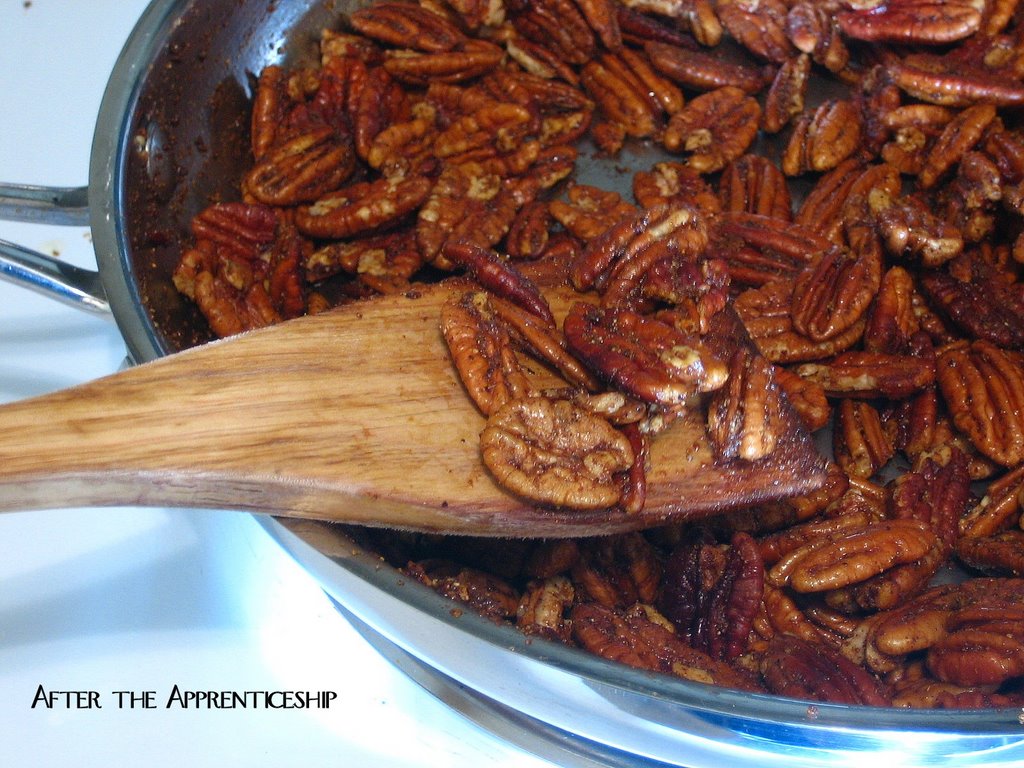
2) In a large saute pan, heat the butter and oil over medium heat. Add the nuts, coat thoroughly with the oil, and stir until they begin to toast and are fragrant.


3) Add the spice mixture to the saute pan and coat the nuts evenly.

4) When the nuts are brown (about 4 minutes), sprinkle on the lime juice and cook until the nuts are dry (about 1-2 minutes).


5)Remove the nuts from the heat and cool completely on a baking sheet.

See? Quick and easy.

Kitchen Tips

*To make clarified butter, warm butter in a sauce pan over medium heat. Once it has completely melted take it off of the heat and let it cool for about five minutes. Skim the white foam off of the top. If you look into the bottom of the pan you will see white milk solids settling on the bottom. Carefully pour the clear yellow liquid (the clarified butter) leaving the milk solids on the bottom of the pan. The reason to clarify butter? It has a higher smoke point which means it can withstand higher temperatures without burning. Want to know more? Check out cooking for engineers.

November 18, 2006

All Mixed Up


Gourmet. Food & Wine. Cooks Illustrated. Savour. All of the November back issues were flipped open and spread out on the dining room table. A feast for the eyes and imagination -- a glimmer of what was to come on Thanksgiving. But, of course, it was a vision of unattainable perfection.

It was Wednesday, just shy of a week from Thanksgiving, and I was planning the annual feast. My goals were lofty: a completely planned meal and accompanying grocery list by morning's end. However, I had a looming deadline teasing me in the back of my brain. One cranberry apple pie promised to Jenny for her party on Friday and I had yet to make the dough. So this really wasn't the morning to be lingering over coffee and my dreamy magazines.

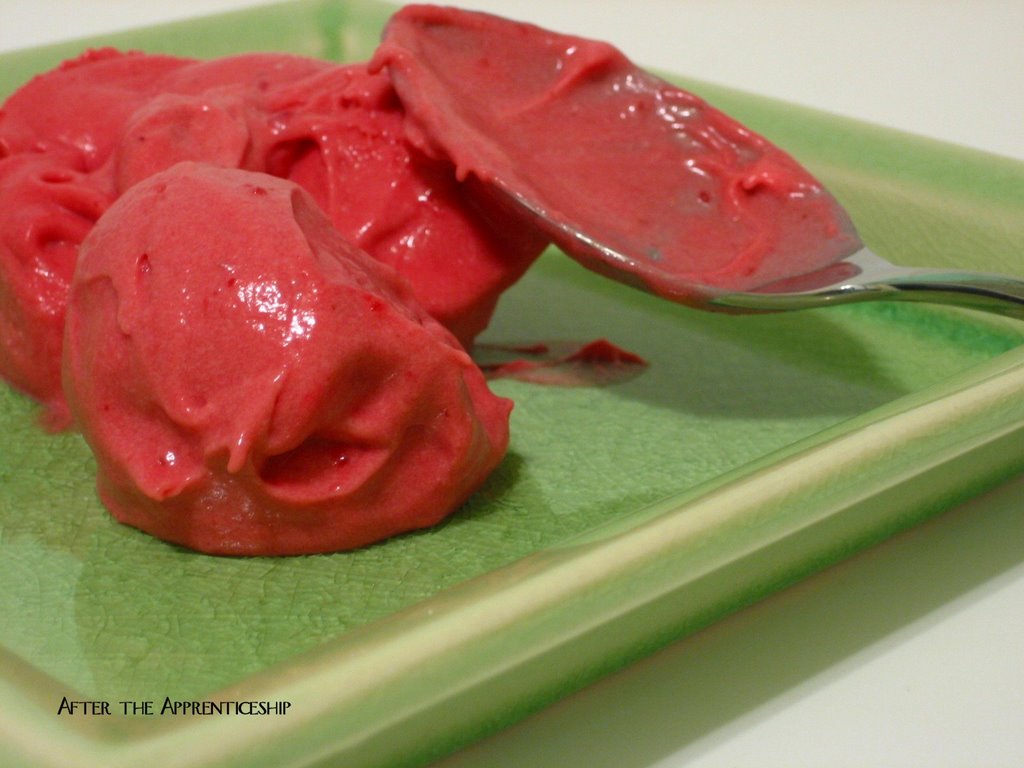
As I was flipping through Gourmet, something caught my eye. It was a recipe for cranberry ice cream. I was planning on picking up a half-gallon of vanilla to go with the pie at the grocery store, but how good would it be to have homemade ice cream? And the cranberry in the pie would be a perfect match to the sweet creamy confection. I could taste it already....


Now where was I again? Thanksgiving dinner, right. That would have to wait. My ice cream maker was calling to me from the depths, and I mean depths, of my cupboard.

After a lot of finagling with various canning equipment, the cast iron dutch oven, and all of the lids for my pots and pans I found it. The ice cream maker. It needed to be dusted. Actually it was my ice cream making skills that needed to have the cobwebs blown off. But I was sure the ice cream would be ready for its debut with my yet-to-be-made pie. Quite sure.

After re-reading the recipe I realized maybe I had been a bit too sure. This was going to take some work. Cranberry ice cream doesn't come easy. The first challenge? Equipment. I was able to overcome the biggest hurdle, the ice cream maker, by randomly receiving Nana's this summer. If you don't have an ice cream maker I would say that this recipe will be nigh impossible, unless you subscribe to the coffee can method.

The other equipment needed (or highly recommended) that I didn't have? For one, a blender. Secondly? A stand mixer. I called Heather. She is my blender girl and I was desperate.

Me: "Heather?"
Heather: "Yea??"
Me: "Can I borrow your blender?"
Heather: "Sure. When do you need it?"
Me: "Weeeellll, actually... now?"


This is why carefully reading through a recipe is critical. So when the cream and sugar are heating to a very specific temperature on the stove and the cranberries are almost done you don't read the next line of the recipe and see "transfer cranberry mixture to a blender and puree until smooth." Huh? How did I not see that before? Back to the desperate call to Heather.

Heather: "Well I was just going to leave for class, I'm running a little late and it is almost finals week..."
Me: "I'll just come over real quick."
Heather: "Alright..."

Now I could have sucked it up and not used a blender. I could have used the food mill, but I can assure you it wouldn't have been as pretty or as easy as using something electric. And the other major equipment hurdle I mentioned earlier? The stand mixer? That wasn't to be easily remedied by a quick phone call. So I plugged in my hand-held mixer and hoped that the motor wouldn't start on fire.

Equipment aside, the trickiest thing about this recipe, which can be overcome with attention and a sieve, is the fact that eggs, when heated, like to congeal. Sugary scrambled eggs in a sauce pot is no laughing matter, especially when you are expecting a creamy custard.

There are two steps in the recipe that have the potential to turn the egg mixture not into the luscious custard you want but rather into a breakfast dish. The first is step number 3. When you add the hot cream to the eggs, add a little cream at first, then stir. Add a little more cream. Stir. Add the rest of the cream in a steady and self-confident stream. Stir. By doing this, tempering the eggs, you are slowly heating them instead of shocking them with a blast of hot cream. The other step with a high potential of congealed eggs? The second part of step 3. When you heat the eggs and the cream in the saucepan, follow the instructions and don't heat the eggs over 170 degrees (if you don't have a thermometer just don't let the mixture boil). After the second part of step 3 pour the custard through a sieve. Any evidence of congealing that happened in the past two steps will be erased with a quick spin through a fine-mesh sieve.


Cranberry Ice Cream
Adapted from Gourmet Nov. 2005

Ingredients
-- 2 C heavy cream
-- 1 and 1/2 C plus 3 Tbs Sugar
-- 6 egg yolks
-- 1/8 t. salt
-- 4 C (24 oz) fresh / frozen cranberries


Directions

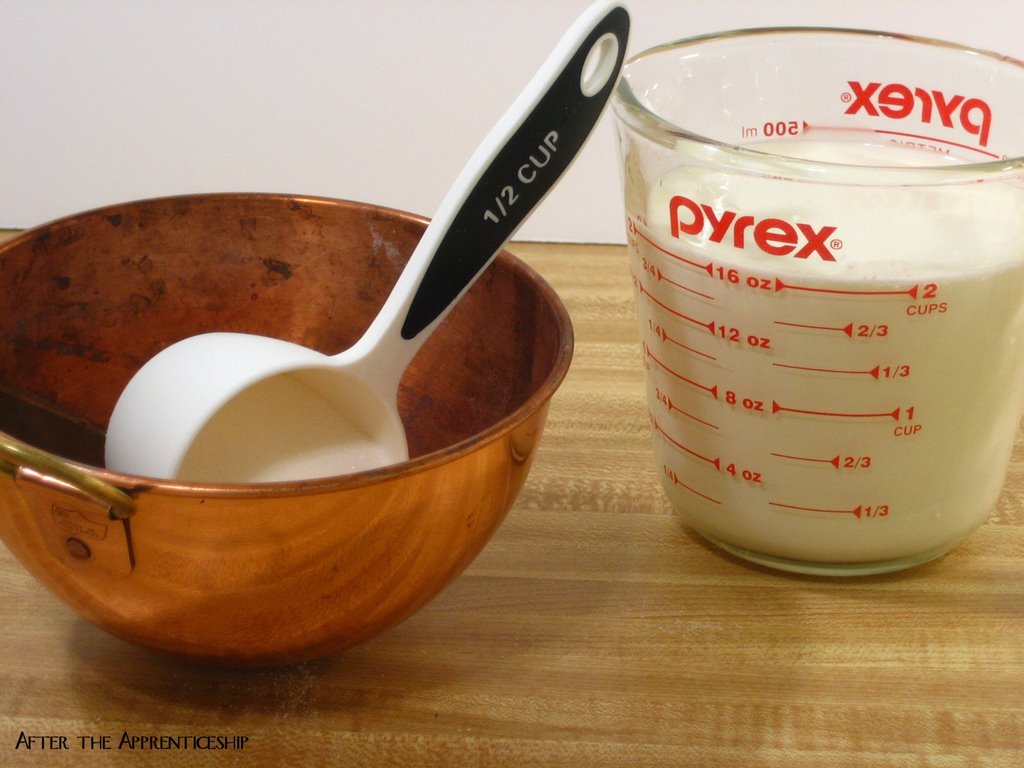
1) In a medium saucepan, bring cream and 1/2 cup of the sugar to a boil. Stir from time to time to dissolve the sugar. Take off of the heat and cover.


2) With a mixer (preferably a stand mixer) beat together the yolks, salt, and 3 Tbs of sugar. The goal is to triple the volume of the yolk mixture and make sure it is thick enough that it forms "The Ribbon"* that can hold for 2 seconds. This will not take long with a stand mixer. If you have a hand-held mixer I hope that you have a good book to read because this is going to take awhile-about 10 minutes.
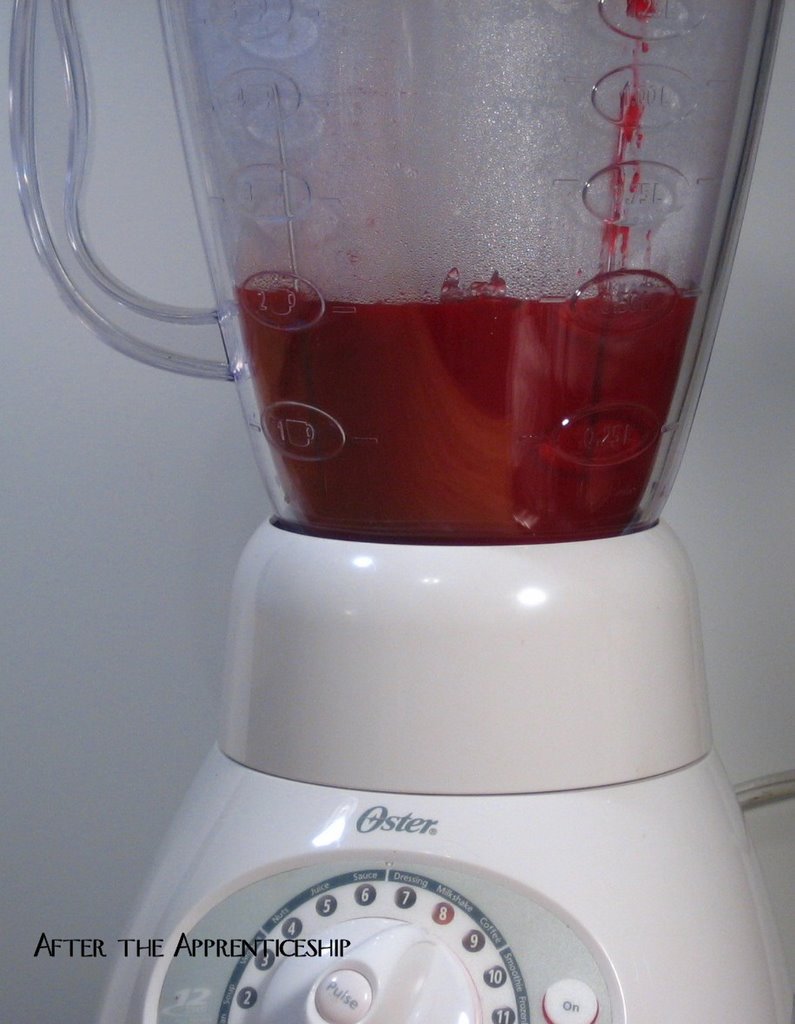
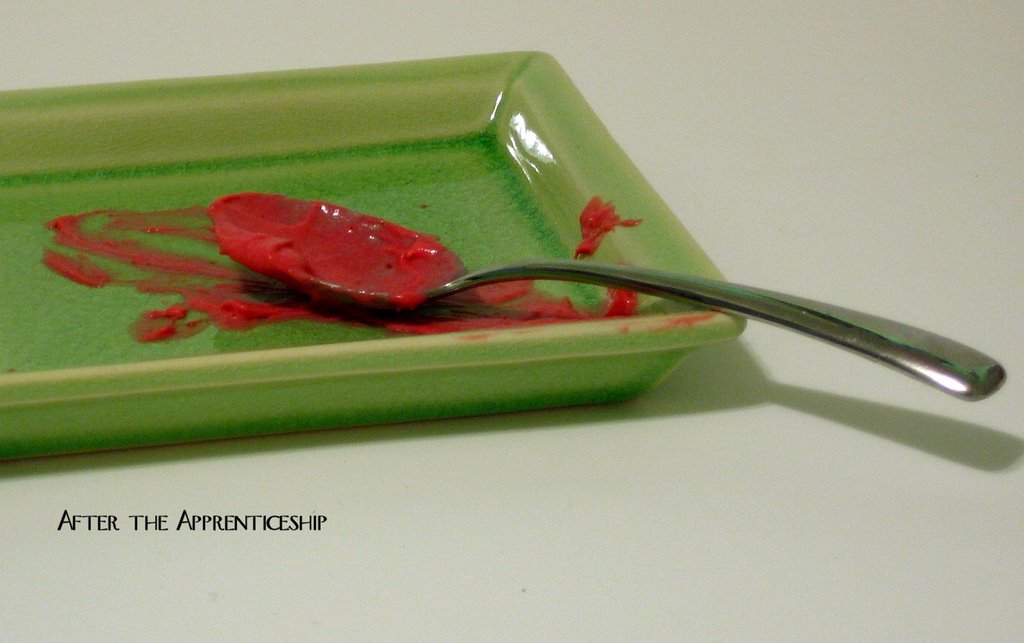
3) Begin mixing at a low speed and begin to slooooooowly pour in the hot cream mixture. Once it has all been added, pour it all back into the saucepan and begin to heat, stirring (I suggest flat-bottomed wooden spoon, but use whatever suits your fancy), until the custard reaches 170 degrees and becomes thickened. Remember, you don't want scrambled eggs.


4) Strain the custard through a fine-mesh sieve and let it cool to room temperature.

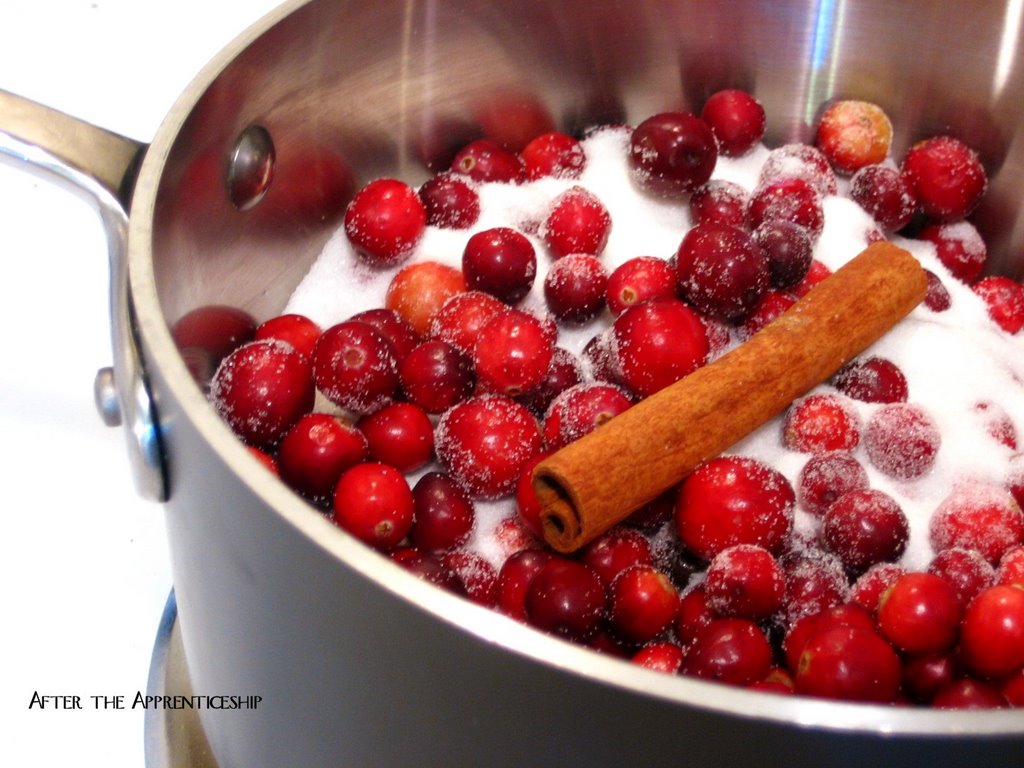
5) In a heavy saucepan, combine the cranberries and the remaining sugar. Bring the mixture to a boil over medium high heat, stirring. Once it reaches a boil, reduce the heat to low and simmer, covered. Stir occasionally. Simmer until the cranberries burst.

(The original recipe called for a cinnamon stick. I found that I didn't even notice a hint of the spice in the ice cream.)
6)Puree the cranberries in a blender until they are smooth. Press the cranberry mix through a fine sieve. Mix with the custard. Chill the mixture in the fridge. This will take about an hour.

7) Pour the chilled custard into your ice cream maker. Once your ice cream maker has done its work, freeze the ice cream for at least 5 hours, overnight is best.

Quick Tips

  • The recipe calls for 1 1/2 Cups + 3 Tbs sugar. Just remember that in the first step, not all of the sugar is used. Mix only 1/2 cup of the sugar with the cream. The rest of the sugar will be used later.
  • A standard 1 -1 1/2 quart ice cream maker is the perfect size for this recipe.
  • Remember, there is a lot of heating, then cooling, then heating, then cooling, and then freezing involved. This all takes time. I would highly suggest making this the day before you would like to eat it.

    *Julia Child in Mastering the Art of French Cooking has a perfect description of how to form The Ribbon when beating egg yolks and sugar. I won't try to reinvent the wheel. Here are Julia's instructions: "To accomplish it [the ribbon], add the sugar gradually to the egg yolks in a mixing bowl while beating with a wire whip or an electric beater; continue beating for 2 to 3 minutes. The mixture will turn a pale, creamy yellow, and thicken enough so that when a bit is lifted in the beater, it will fall back into the bowl forming a slowly dissolving ribbon on the surface of the mixture. Do not beat beyond this point or the egg yolks may become granular."